
Pro version
Windows version of this calculator with lifetime upgrades and support for only $59.
Trusted by the world’s greatest companies.


VoIP Bandwidth Calculator instructions
This VoIP Bandwidth calculator estimates the bandwidth that a known number of voice paths will occupy through your IP-based network. It will also calculate how many voice paths a specific bandwidth can cater for. Before performing a calculation, you need to provide details of your voice compression scheme in the first two areas of the calculator:
- Use the first drop down box to select the CODEC being used. CODECs convert between analogue voice signals and data streams, through sampling and quantisation. CODECs vary in their quality and delay characteristics, with G.723.1 and G729A being the most common CODECs for low-bitrate compressed applications and G.711 being used for higher quality lossless compression.
- The frequency at which the voice packets are transmitted has a significant bearing on bandwidth. The selection of the packet duration (and therefore the packet frequency) is a compromise between bandwidth and quality. A lower duration requires more bandwidth but, as the duration is lengthened, the system’s delay increases and it becomes more susceptible to packet loss. 20 ms is a typical value.
The VoIP Bandwidth calculator can estimate either the number of voice paths or the IP bandwidth. Choose which parameter you want to calculate by clicking the button in that section. Enter the known value into other box and press Calculate.
For example, to work out how much bandwidth is required to transmit 10 voice paths (or channels) through an IP network using the G.723.1 (6.4 kbps) coding scheme with 30 ms packet duration, enter those values into the calculator. When you press Calculate, the result will be displayed: 171 kbps.
Mechanisms are being developed to reduce the overhead of IP / UDP and RTP headers; examples include RTP header compression and multiplexing. This calculator does not take these into account. Nor does it consider the bandwidth occupied by datalink (layer 2) protocols such as Ethernet or ATM.
Windows version
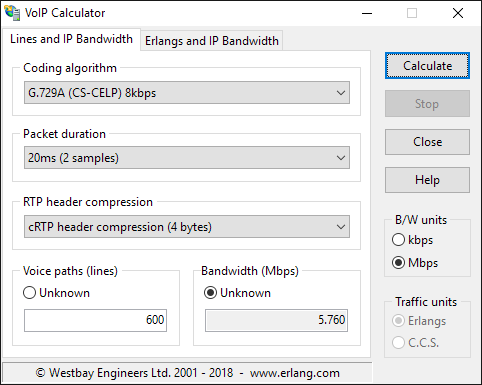
VoIP Calculator is our simple-to-use Windows products that includes a VoIP bandwidth calculator and an Erlangs to IP bandwidth conversion tool. Although based on our online calculators, it also models RTP header compression (cRTP) and supports calculations up to 100,000 lines and 20 Gbps.
Free upgrades for life on a single computer for a once-only charge of just $59.